The Ghost in the Machine: Why Millions of Workers Don’t Exist
The Monthly Jobs Report is Often Wrong (and How to Fix It)


We are faced with “poor” employment growth. No matter how I analyze the numbers, I come to the same conclusion. But those who have followed me over the years know I am far from enamored with how these numbers are fabricated derived, combined with the built-in error due to methodology.
Industrial engineers know to capture data at natural pulse points for maximum accuracy and minimal distortion. In manufacturing, quality control, or workflow analysis, this means timing measurements or sampling at inherent, recurring cycle endpoints—like the end of a shift, completion of a batch/production run, machine cycle finish, payroll closeout, or inventory count reconciliation—where data naturally “settles” without artificial intervention - taking data at a point where they are counted anyway. Sampling at these points reduces noise from mid-process variability, avoids extrapolation errors, and yields more reliable indicators of true system performance.
Applying this principle to the BLS monthly employment report, the current methodology falls short in key ways.
The initial monthly employment estimate is based on the pay period with the 12th, even though pay cycles vary widely—weekly, biweekly, semimonthly, monthly—so the reference period can capture different points in a company’s natural payroll rhythm, introducing inconsistency or misalignment.
Estimates depend on a voluntary sample with low response rates (~40–45% recently), heavy imputation for non-respondents, and statistical models (birth-death for new/closing firms), which add layers of estimation rather than pure observation at the source.
True “hard” pulse points—like actual payroll tax deposits, UI wage reports, or electronic payroll processor snapshots—happen more granularly and frequently but aren’t fully tapped monthly due to lags and aggregation rules.
This is why alternatives like the ADP Employment Report (from payroll processor data) or proposals to accelerate quarterly UI tax records appeal to the natural-pulse mindset: ADP draws from real-time payroll transactions across millions of workers, often aligning closer to actual pay-cycle endpoints without survey delays, while expanded administrative data (e.g., more frequent UI filings or IRS/SSA payroll flows) could create a near-census at true system beats (when taxes are withheld/reported). Even ADP adjusts its monthly snapshot to the BLS reference period (week including the 12th) for comparability, but its underlying data flow from natural payroll events.

Background
The U.S. Bureau of Labor Statistics (BLS) methodology for determining monthly employment changes primarily uses the Current Employment Statistics (CES) survey, which produces the headline nonfarm payroll figures. The methodology has contributed to unusually large and frequent revisions, including downward benchmark adjustments that have ranked among the biggest in decades—for instance, the seasonally adjusted total nonfarm employment level for March 2025 was revised downward by 898,000. On a not seasonally adjusted basis, the total nonfarm employment level for March 2025 was revised downward by 862,000, or -0.5 percent. Not seasonally adjusted, the absolute average benchmark revision over the prior 10 years is 0.2 percent. The change in total nonfarm employment for 2025 was revised from +584,000 to +181,000 (seasonally adjusted)
These revisions have grown larger and less predictable since the pandemic, eroding public and market confidence in the initial headline numbers that influence policy, Federal Reserve decisions, and financial markets, with some attributing the problem to outdated procedures, insufficient funding (with inflation-adjusted budget constraints), and a failure to fully modernize data collection through incentives or digital tools.
The birth-death model, which estimates net job creation from new business formations (births) offsetting closures (deaths) since the survey cannot immediately capture these changes, has faced particular scrutiny for overestimating employment during periods of economic cooling or unusual churn, such as when post-pandemic business formation included more marginal firms prone to quick failure; this model, reliant on historical trends and residuals, has strained under recent dynamics, leading to overstated preliminary growth that benchmarks later correct downward using more comprehensive Quarterly Census of Employment and Wages (QCEW) tax records. Seasonal adjustment processes, which use concurrent methods to re-estimate factors monthly, have also been flagged for potential distortions in volatile times, sometimes amplifying end-of-year or holiday-related artifacts.
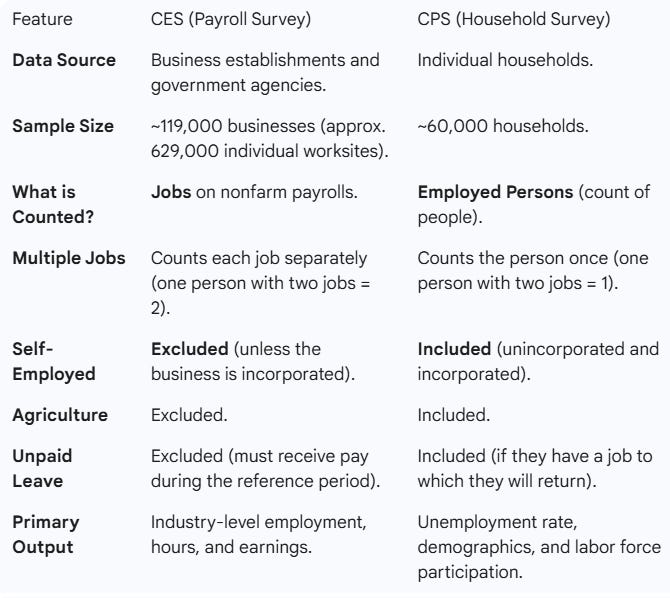
Broader methodological limitations include the CES survey’s focus on payroll jobs (counting W-2 wage and salary positions) based on any worker who was active or received compensation during the pay period that includes the 12th of the month. This includes a broad spectrum of roles, ranging from full-time and part-time staff to temporary and intermittent workers, provided they appear on the formal payroll.
The CES excludes true independent contractors, most gig workers, self-employed individuals, workers on small agricultural farms, and private household employees, meaning it tracks jobs rather than people and can diverge from household-based surveys like the Current Population Survey; this has led to accusations that headline figures miss key aspects of the modern labor market’s shift toward nontraditional work.
While many economists defend the revisions as normal, it is stupid to defend a system that provides the wrong answer to the extent that poor decisions are being made.
Enter the Uncounted Employment