April 2025 Economic Forecast: Quantifying the Impacts of Change

EconCurrents‘ Economic Index marginally improved. There are several continuing recession flags but we continue forecasting no recession in the near term. Read on to understand the currents affecting our economic growth.


Overview of this Economic Forecast
This post will summarize the:
special indicators,
leading indicators,
predictive portions of coincident indicators,
review of the technical recession indicators, and
interpretation of our index – EconCurrents Economic Index (EEI) – which is built of mostly non-monetary “things” that are indicative of the direction of the Main Street economy at least 30 days in advance.
In preparing an economic forecast, there are President Trump issues which, depending on how they are implemented & what the counter-responses are, can effect economic growth. I believe there will be little lingering impact overall - but this is an opinion and not fact. I no longer believe a slight recession is built-in caused by all the changes - but a recession remains possible if certain scenarios play out.
Key issues suppressing economic growth
Trade Tensions and Tariffs
The implementation of new trade policies and tariffs by the Trump administration could significantly impact economic growth prospects. The OECD projected a slowdown in global GDP growth, attributing it to heightened trade barriers in various G20 nations. The potential introduction of substantial tariffs, including a 60% tariff on all goods from China and a 20% tariff on goods from other trading partners, could result in a major reduction in both exports and imports, leading to a broad economic slowdown.
Immigration Policies
Stringent immigration policies posed a risk to job creation and economic growth. With labor market dynamics at the time, increasing the size of the labor force was crucial for filling jobs and driving economic growth. Potential large-scale deportations and border closures could significantly reduce job creation and cut GDP growth. I suspect immigration policies will evolve if this issue surfaces.
Inflation Pressures
Inflationary pressures continued to linger. The OECD projected higher-than-expected inflation, with U.S. headline inflation forecasted at 2.8% for 2025. Persistent services price inflation and the potential for trade restrictions to push up prices added to these concerns.
Policy Uncertainty
High levels of policy uncertainty pose risks to economic growth. This uncertainty affected business and consumer confidence, potentially impacting spending and investment decisions. This issue may evaporate or worsen as businesses and people begin to see the impact of the change.
Issues potentially improving economic growth:
Tax Cuts and Extensions
Trump aims to extend and expand the Tax Cuts and Jobs Act (TCJA) of 2017, set to expire at the end of 2025. This includes maintaining lower individual tax rates, increasing the standard deduction, and keeping the corporate tax rate at 21% or reducing it further to 15% for companies producing domestically. He has also proposed eliminating taxes on tips, Social Security benefits, and overtime pay, alongside offering new tax credits, such as one for family caregivers. These measures are intended to boost disposable income and incentivize domestic production, though economists warn they could increase federal deficits by trillions over the next decade if not offset by spending cuts or new revenue.
Deregulation
Trump has emphasized reducing regulatory burdens to stimulate economic growth. Early actions include executive orders to expedite environmental approvals for energy projects and roll back efficiency standards on appliances, signaling a broader push to ease restrictions on industries like energy, manufacturing, and finance. His administration claims this will lower costs and boost investment, though critics argue it might increase long-term risks, such as environmental damage or financial instability.
Energy Production and Cost Reduction
Trump has vowed to increase domestic fossil fuel production—oil, gas, and coal—by cutting drilling permit approval times and expanding output to make the U.S. a dominant global energy producer. He claims this will halve energy costs within his first year, aiming to reduce inflation. However, global energy markets and external factors may limit the extent of price drops, and some analysts suggest these policies could conflict with inflation goals if paired with tariffs.
Changes caused by the current immigration policies and reduction of government spending (including DOGE) should have a neutral economic impact.
Economic trends remain unchanged until a new force acts on them. Except for “black swan” events, economic change is relatively slow and gradual.
The economy continues to be stratified with some sectors going gangbusters, other sectors barely above recessionary levels, whilst other sectors are in recession territory. This stratification became noticeable after the Great Recession of 2007 - especially with the extraordinary monetary policy (quantitative easing) caused the economy to act differently than historical benchmarks would suggest.
I am reminded that recession indicators are based on models produced using historical data – and significant annual revisions by the US Census, BLS, and the BEA change how we interpret the data. The bottom line is that we can never fully trust current data or trend lines as correct. Let’s say that all forecasts are no more than quantified opinion.
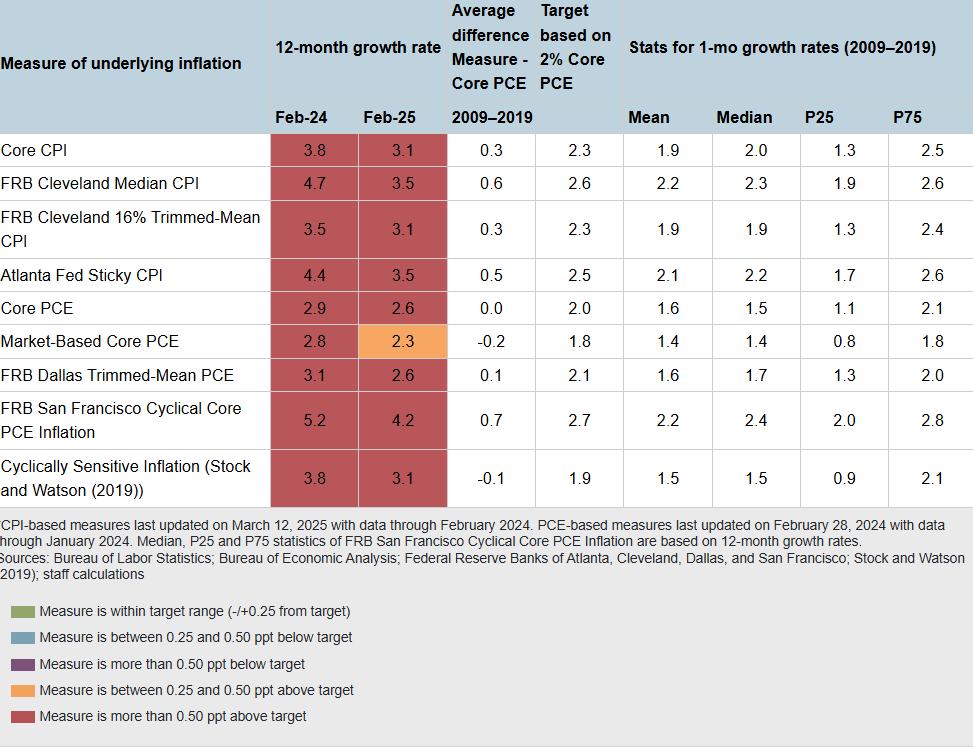
The Federal Reserve has made three recent reductions to the federal funds rate. The private sector borrowing rates have changed a little suggesting it was premature to reduce rates. EconCurrents follows the Federal Reserve Bank of Atlanta’s Underlying Inflation Dashboard which uses data from the US Bureau of Economic Analysis, the Federal Reserve Bank of San Francisco, and the Federal Reserve Bank of Dallas. Inflation has modestly declined earlier this year but, interestingly, the downward movement in some of the measures of inflation released since September 2024 were mostly matched by upward movement of others. Inflationary pressures remain high - and inflation continues to impact any economic forecast.